Tuesday, August 23, 2011

Ferrari 430 Scuderia Spider 16M

2009 Ferrari 430 Scuderia Spider 16M
2009 Ferrari 430 Scuderia Spider 16M Pictures
2009 Ferrari 430 Scuderia Spider 16M pics
2009 Ferrari 430 Scuderia Spider 16M Pictures
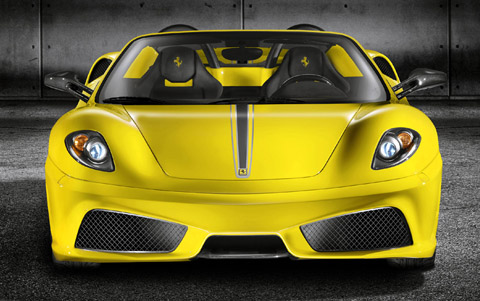
2009 Ferrari 430 Scuderia Spider 16M photos
2009 Ferrari 430 Scuderia Spider 16M Pictures

Wednesday, August 17, 2011

Jaguar XK120


1950 Jaguar XK120 roadster on later wire wheels;
leather strap and bonnet louvres also unoriginal
Manufacturer Jaguar Cars
Production 1948–1954
12,055 made 
Predecessor Jaguar SS100
Successor Jaguar XK140
Class Sports car
Body style 2-seat roadster (OTS)
2-seat coupé
2-seat Drop Head Coupé
Layout FR layout
Engine 3.4 L XK I6
Wheelbase 102 in (2,591 mm)
Length 173 in (4,394 mm)
Width 61.5 in (1,562 mm)
Height 52.5 in (1,334 mm)
Related Jaguar C-Type

Bugatti Veyron


Manufacturer Bugatti Automobiles and Volkswagen Group
Production 2005–present (Last Bugatti Veyron 16.4 sold)
Assembly Molsheim, Alsace, France
Predecessor Bugatti EB110
Class Sports car
Body style Standard: 2-door coupé
Variant: targa top
Layout Longitudinal mid-engine,
permanent all-wheel drive
Engine Standard:
8.0 L (488 cu in) W16 quad-turbocharged 1,001 PS
Super Sport:
1,200 PS (883 kW; 1,184 bhp)
Transmission 7-speed DSG sequential
Wheelbase 2,710 mm (106.7 in)
Length 4,462 mm (175.7 in)
Width 1,998 mm (78.7 in)
Height 1,159 mm (45.6 in)


The Bugatti Veyron EB 16.4 is a mid-engined grand touring car. The Super Sport version is the fastest road-legal car in the world, with a top speed of 431.07 km/h (267.85 mph). The original version has a top speed of 408.00 km/h (253.52 mph). It was named Car of the Decade (2000–2009) by the BBC television programme Top Gear.

Designed and developed by the German Volkswagen Group and produced by Bugatti Automobiles SAS at their headquarters in Château Saint Jean in Molsheim (Alsace, France), the Veyron's chief designer was Hartmut Warkuss, and the exterior was designed by Jozef Kabaň of Volkswagen, with much of the engineering work being conducted under the guidance of former Peterbilt engineer and now Bugatti Engineering chief Wolfgang Schreiber.

A number of special variants have been produced, including two targa tops. In December 2010, Bugatti began offering prospective buyers the ability to customize exterior and interiors colours by using the Veyron 16.4 Configurator application on the marque's official website.

McLaren F1


Manufacturer McLaren Automotive
Production 1992–1998
(106 produced)
Assembly Woking, Surrey, England
Successor McLaren MP4-12C
Class Sports car
Body style 2-door 3-seat coupé
Layout RMR layout
Engine 60° 6.1 L BMW S70/2 V12
Transmission 6-speed manual
Wheelbase 2,718 mm (107.0 in)
Length 4,287 mm (168.8 in)
Width 1,820 mm (71.7 in)
Height 1,140 mm (44.9 in)
Curb weight 1,140 kg (2,513 lb)
Related McLaren F1 LM
McLaren F1 GTR
Designer Gordon Murray & Peter Stevens

The McLaren F1 is a supercar designed and manufactured by McLaren Automotive. Originally a concept conceived by Gordon Murray, he convinced Ron Dennis to back the project and engaged Peter Stevens to design the exterior of the car. On 31 March 1998, it set the record for the fastest road car in the world, topping at 231 mph (372 km/h) with rev limiter on, and 240 mph (386.24 km/h) with rev limiter removed.

The car features numerous proprietary designs and technologies; it was designed and built with no compromises to the original design concept laid out by Gordon Murray. It is lighter and has a more streamlined structure than even most of its modern rivals and competitors despite having one seat more than most similar sports cars, with the driver's seat located in the middle (and slightly forward of the passengers seating position providing excellent driving visibility). It features a powerful engine and is somewhat track oriented, but not to the degree that it compromises everyday usability and comfort. It was conceived as an exercise in creating what its designers hoped would be considered the ultimate road car. Despite not having been designed as a track machine, a modified race car edition of the vehicle won several races, including the 24 Hours of Le Mans in 1995, where it faced purpose-built prototype race cars. Production began in 1992 and ended in 1998. In all, 106 cars were manufactured, with some variations in the design.

In 1994, the British car magazine Autocar stated in a road test regarding the F1, "The McLaren F1 is the finest driving machine yet built for the public road." and that "The F1 will be remembered as one of the great events in the history of the car, and it may possibly be the fastest production road car the world will ever see.".

Jaguar XK120


Manufacturer Jaguar Cars
Production 1948–1954
12,055 made 
Predecessor Jaguar SS100
Successor Jaguar XK140
Class Sports car
Body style 2-seat roadster (OTS)
2-seat coupé
2-seat Drop Head Coupé
Layout FR layout
Engine 3.4 L XK I6
Wheelbase 102 in (2,591 mm)
Length 173 in (4,394 mm)
Width 61.5 in (1,562 mm)
Height 52.5 in (1,334 mm)

The XK120 was launched in roadster form at the 1948 London Motor Show as a testbed and show car for the new Jaguar XK engine. It caused a sensation, which persuaded Jaguar founder and design boss William Lyons to put it into production.

The "120" in its name referred to its 120 mph (193 km/h) top speed (faster with the windscreen removed), which made the XK120 the world's fastest standard production car at the time of its launch.

It was available in two 'open' versions – first as the roadster (designated OTS, for open two-seater, in America), then, also as a drophead coupé, DHC, from 1953 – and as a closed, or "fixed-head" coupé (FHC) from 1951. The DHC was a more deluxe open model, featuring the wood dashboard and wood accent veneers on the interior as found on the FHC.

The roadster version was successful in racing.

The Motor magazine road-tested an XK120 roadster in 1949. With hood and sidescreens in place, it achieved a top speed of 124.6 mph (200.5 km/h), accelerated from 0–60 mph (97 km/h) in 10.0 seconds and consumed fuel at the rate of 19.8 miles per imperial gallon (14.3 L/100 km; 16.5 mpg-US). The car as tested cost £1263 including taxes.

In May 1949, Jaguar demonstrated an XK120 roadster to the press on the high-speed autoroute between Jabbeke and Aeltre in Belgium. The road was closed for the occasion. The white left-hand drive car, chassis number 670002, was the second XK120 built. Jaguar's development engineer Walter Hassan was to have driven but fell ill, so Jaguar test-driver Ron "Soapy" Sutton substituted for him. With hood and sidescreens erected, and the airflow under the car improved by the addition of a full-length aluminium undertray, the Jaguar was timed through the flying mile by the Royal Automobile Club of Belgium at 126.448 mph (203.498 km/h). With hood, sidescreens and windscreen removed, a metal airflow deflector fitted in front of the driver, and a tonneau cover fastened over the passenger side of the cockpit the speed improved to 136.596 mph (219.830 km/h). The XK120 showed itself to be the fastest production car in the world.

Tuesday, August 2, 2011

Lamborghini Diablo

Manufacturer Lamborghini
Production 1990–2001
2884 produced
Predecessor Lamborghini Countach
Successor Lamborghini Murciélago
Class Sports car
Body style 2-door coupe
2-door roadster
Layout Mid-engine, RWD / AWD
Engine 5.7 L V12
6.0 L V12
Transmission 5-speed manual
Wheelbase 2,650 mm (104.3 in)
Length 4,460 mm (175.6 in)–4,470 mm (176.0 in)
Width 2,040 mm (80.3 in)
Height 1,105 mm (43.5 in)–1,115 mm (43.9 in)

The Lamborghini Diablo is a high-performance mid-engined sports car that was built by Italian automaker Lamborghini between 1990 and 2001. It was the first Lamborghini capable of attaining a top speed in excess of 200 miles per hour (320 km/h). After the end of its production run in 2001, the Diablo was replaced by the Lamborghini Murciélago.

The Diablo was presented to the public for sale on January 21, 1990, at a base price of $240,000 at the Hotel de Paris in Monte Carlo during the second Lamborghini Day. Power came from a 5,709 cc (348 cu in), 48-valve version of the existing Lamborghini V12 featuring dual overhead cams and computer-controlled multi-point fuel injection, producing a maximum output of 499 PS (367 kW; 492 hp) and 580 N·m (428 lb·ft) of torque. The vehicle could reach 100 km/h (62 mph) in about 4.5 seconds, with a top speed of 202 mph (325 km/h). The Diablo was rear-wheel drive and the engine was mid-mounted to aid its weight balance.

The Diablo came better equipped than the Countach had; standard features included fully adjustable seats and steering wheel, electric windows, an Alpine stereo system, and power steering. Anti-lock brakes were not initially available, although they would eventually be used. A few options were available, including a custom-molded driver's seat, remote CD changer and subwoofer, rear spoiler, factory fitted luggage set (priced at $2,600) and an exclusive Breguet clock for the dash (priced at $10,500).

The Diablo was the fastest production car in the world for the 1991 model year, having a top speed of 333 km/h (207 mph), which exceeded the 324 km/h (201 mph) of the previous title-holder, the Ferrari F40. The Diablo held the title until the release of the Bugatti EB110 in 1991, which claimed a top speed of 343 km/h (213 mph).

Sunday, July 10, 2011

The Red Ferrari F40


Manufacturer Ferrari
Production 1987–1992 (1,315 produced)
Assembly Maranello, Italy
Predecessor Ferrari 288 GTO
Successor Ferrari F50
Class Sports car
Body style Berlinetta (2-door coupé)
Layout Mid-engine, rear-wheel drive
Engine 2,936 cc (2.9 L) twin-turbocharged V8 478 PS
(352 kW; 471 hp)
Transmission 5-speed manual
Wheelbase 2,451 mm (96.5 in)
Length 4,430 mm (174 in)
Width 1,980 mm (78 in)
Height 1,130 mm (44 in)
Curb weight 1,100 kg (2,400 lb)


The Ferrari F40 is a mid-engine, rear-wheel drive, two-door coupé sports car produced by Ferrari from 1987 to 1992 as the successor to the Ferrari 288 GTO. From 1987 to 1989 it held the title as the world's fastest street-legal production car, and during its years of production, was Ferrari's fastest, most powerful, and most expensive car. The car had no traction control, and was one of the few to utilize turbochargers.

The car debuted with a factory suggested retail price of approximately US$400,000,[citation needed] although some buyers were reported to have paid as much as US$1.6 million. A total of 1,315 F40s were produced.

Body and interior
The body was an entirely new design by Pininfarina featuring panels made of kevlar, carbon fiber, and aluminum for strength and low weight, and intense aerodynamic testing was employed. Weight was further minimized through the use of a plastic windshield and windows and no carpets, sound system, or door handles were installed although the cars did have air conditioning. The first 50 cars produced had sliding Lexan windows, while later cars were fitted with normal windows that could be rolled down.
Related Posts Plugin for WordPress, Blogger...